
Transcriber's note: Unusual and inconsistent spelling is as printed.
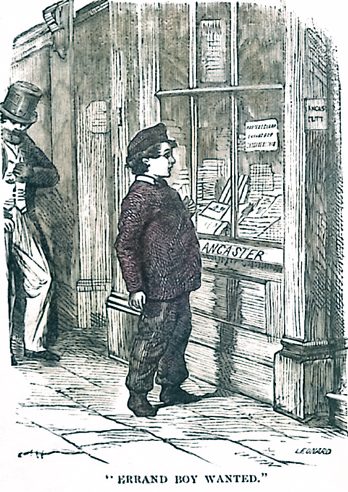
"ERRAND BOY WANTED."
BY THE AUTHOR OF
"Basil: or, Honesty and Industry," "Harry Blake's Trouble,"
etc.
[Charlotte O'Brien]

LONDON:
THE RELIGIOUS TRACT SOCIETY
56, PATERNOSTER ROW; 65, ST. PAUL'S CHURCHYARD;
AND 164, PICCADILLY.
CONTENTS.
CHAP.

BEN HOLT'S GOOD NAME

IT is no uncommon thing to hear children say, "how happy they should be if they were but rich." They seem to think people must be happy who live in grand houses and "fare sumptuously every day." Many a little boy, as he opens a common-gate to let a fine carriage pass through, has secretly envied those who were riding in it, and has thought what a good thing it must be to be borne about from place to place in a beautiful carriage, as easy as a bird and as grand as a prince.
Ah! Little boy, if you could have known what the lady in the carriage was thinking as she looked at your healthy, ruddy cheeks, and your merry countenance, you might have felt very differently on the subject. It is very likely that, weary with all the "pomp and vanities" of the empty world of fashion, something very like a sigh escaped from her as she thought, "How pleasant to have lived like that child amongst the blossoming May trees on the wild common, and never to have known the falsehoods of fashion and the evil ways of the world."
Some years ago an artist painted a picture, and named it "As happy as a king." What do you think the subject was? Perhaps you will imagine that it was some grand prince riding in a gilded chariot, drawn by cream-coloured horses, with music playing and soldiers in gay uniforms marching before and behind. Or it was a banquet, where all the guests were drinking out of golden cups. Nothing of the kind. It was simply a little peasant boy riding on the top of a five-barred gate, and waving his arms joyfully in the air as the gate swung to and fro.
But I do not want you to take my word alone for what I am saying. The Bible confirms what I have just been saying, but I will only quote one verse, which was written by the wisest of men; and he was not only the wisest, but the richest and most powerful monarch of his time. He was the "Solomon in all his glory" of whom our Saviour spake—the king whose throne was of "ivory, overlaid with the best gold," and who had none but golden drinking vessels. Surely "he" must have known the true value of riches! And what does he say?
"A good name is rather to be chosen than great riches."
Now, a good name may be possessed by every child who prays to God for grace and strengths to "live soberly and righteously in this present world." Moreover, riches often "make themselves wings, and fly away." And we know that even if they remain with us during our lives, we must lose them all when we die. But a good name will remain with us for ever and ever, and will do good in the world after our bodies are laid in the dust. The names of Samuel and David, of Luther and Howard, are still doing good in the world by the remembrance of the example they left behind them. The good name of many a simple village youth who was led during his short earthly life to trust in the merits of his Saviour, and who proved in whom he trusted by obedience to his parents, and by his honesty and good conduct, still lingers around his cottage home, an encouragement to his companions to "go and do likewise."
"The sweet remembrance of the just
Shall flourish when they sleep in dust."
Are we then to despise riches if God thinks it well to bestow them upon us? By no means. Only we must remember that riches may become a snare to their possessor, and we must pray to God that we may not "trust in riches," or we shall find it very hard to enter into the kingdom of heaven. The true disciple of Christ will value money chiefly as it enables him to do good. He will remember the words of the Lord Jesus, how He said,—
"It is more blessed to give than to receive."
And his riches will be to him as a talent for which he knows he will one day have to give an account. If, on the other hand, God has seen fit, in His infinite wisdom, to place us in a condition of poverty, let us strive to say with St. Paul,—
"I have learned, in whatsoever state I am, therewith to be content."
For we may be quite sure that God knows far better than we do ourselves what is and what is not good for us.
The story we are about to tell is of a little boy who, whilst still very young, was enabled, through God's grace, to gain for himself a "good name." We think you will admit, when you have read his history, that this good name was of great value to him.
Ben Holt was a poor boy, and at the time when he first gained his good name, he had never seen such a thing as a green field in the country. As to buttercups and daisies, they would have been looked upon quite as "treasures of silver and gold" by the little boy who had lived all his life in a London alley. This alley was so narrow, that the utmost he could see even of the blue sky of heaven was a small strip between the two rows of tall, dirty houses, which were so close together that a person living at one side of the alley could almost shake hands with his opposite neighbour from their respective windows.
If any country child had asked Ben where he lived, the answer would have seemed to him rather puzzling—"White Horse Alley, No. 2, three pair back." And he would require to have it explained to him that there are parts of London, and of most large cities, where poor people live in narrow courts and alleys, and where the rents of even such places are so high that whole families have frequently to be contented with a single room to live in. In many quite small houses of not more than six rooms, sometimes there are twenty people living in them. This would seem very strange to children whose parents live in the country, and who have been brought up in a neat, roomy cottage, with a nice garden, and plenty of pleasant green meadows all around, and who have all their lives breathed the fresh pure air of the country. Such children little know how many more blessings they possess than little boys and girls who live in smoky courts and alleys, and who do not know what it is to walk in a shady green wood, or to gather a nosegay of wild flowers.
Ben Holt was an only child, and his mother was a widow. They lived in a small back room on the third floor of a house in White Horse Alley. That was the meaning of "three pair back." Whilst Ben's father lived, they had been much better off, and had two rooms to themselves on the first floor. He was a porter at a large wholesale house in the city, and received good wages; but he died very suddenly from injuries received in lifting some heavy weights, and then all was changed.
Mrs. Holt had to support herself and Ben by needlework, and could no longer afford the two nice rooms on the first floor. So she was obliged to move into the little top back room, for which poor accommodation she paid as much as the rent of many a four-roomed cottage in the country with a good bit of garden ground besides. But as Mrs. Holt made shirts for a shop near White Horse Alley, she was obliged to live in London, as she had to go to the shop almost every day to fetch or carry home her work.
She was not a woman of much education, having gone to service when very young, on account of the death of both her parents. But she had through life regretted not having had more "schooling;" for though able to read very well, she could not write at all, and she determined that her little Ben should be as good a scholar as she could afford to make him.
Ben, therefore, went regularly to school, and as he was nine or ten years old, he could read a chapter in the Bible without making one mistake, and was beginning to write large-hand very well. "Book-learning" is a very good thing and a very useful thing, but Ben Holt would never have gained his good name by merely knowing how to read and write and cipher. The heart must be cultivated as well as the head, and it is God alone who can do that through His Holy Spirit. Ben's mother knew that very well, and she did what all Christian mothers should do—she prayed to God night and morning for her dear little boy, and also that she might have strength and grace given her to set him a good example, and to bring him up in the right way.
In simple, earnest faith she prayed on, nothing doubting but that she would receive, in God's own time, an answer to her prayers; for she remembered those words of our blessed Saviour—
"Whatsoever ye shall ask, of the Father, in My name, that will I do,
that the Father may be glorified in the Son."

YOU may be quite sure that Ben Holt had not many toys. Whilst his father lived, it had been very different; and the little boy had still the remains of a large wooden horse on four wheels, which had been given to him on his fourth birthday. But the wheels were all broken, and only one leg remained; yet still Ben clung to the wreck of his former plaything, for it seemed to remind him of the days when his kind father lived, and when his mother was not obliged to sit and work from morning to night, as she now had to do.
Often and often did Ben wake up after he had been in bed what seemed to him a whole long night, and there was his pale and anxious-looking mother stitching away by the light of a miserable candle, just where he had left her when he went to bed. Then Ben would feel a warm gush of love rise up in his heart for his poor mother, and he would long for the day to come when he should be able to earn enough to keep them both. Sometimes a deep sigh would escape him as he thought how young he was, and how long it would be before he was grown up. Then his mother would look round from her work with a kind smile, and tell him to go to sleep again; or she would leave her work for a moment to make his bed comfortable for him, little knowing the thoughts that were passing through Ben's mind at the time.
Ben was much more thoughtful than boys usually are at his age, one great reason for which was that his mother kept him with her as much as possible, not wishing him to associate with the rude boys in the alley. Having no brothers or sisters, and only his mother for a companion, Ben was rather old-fashioned in his ways for a little boy nearly ten years old. He would stand at the window of the little back room in which they lived, watching the smoke-dried-looking sparrows as they hopped about amongst the tiles and chimney pots. And he would think how beautiful the birds must be that are spoken of in the Bible—doves with silver wings and feathers like gold: he wished he could see some of them.
Sometimes he went with his mother to the shop for which she worked, and as they came home Mrs. Holt would, now and then, turn aside from the crowded, noisy streets, to where a large bridge, more quiet than the others, crossed the busy river. This was a great treat to Ben. He would stand on the stone seats on the bridge, and watch with delight the steamers going up and down, and would wonder whether they went very far, and whether the people in them ever saw doves with "silver wings and feathers like gold."
One day Ben had accompanied his mother to the shop, and whilst she was engaged in talking to the master of the shop about the work, and waiting for some more to be given to her, the little boy amused himself with standing at the door, watching the crowds of people who passed by. He liked doing that very much.
There was a large toy-shop just opposite, and as the street was not very wide, Ben could distinctly see all the pretty tempting things that were displayed in the windows. Drums, trumpets, horses, coaches, and, above all, some large, gaily-painted humming-tops. Ben had always longed-for one of those big humming-tops. He had sometimes seen a little boy spinning one in the parlour of the shop for which his mother worked, and had thought how nice it would be if he could only have one to amuse himself with, in their back room at home. The cheerful humming noise it made was so pleasant; Ben thought it would be as good as having somebody to play with. But he never said anything about it to his mother, for he knew how poor she was, and that sometimes she could hardly find money to pay the rent, for which a stern-looking man used to call every Monday morning. So Ben only stood at the shop door, and longed, perhaps a little more that day than usual, for a painted humming-top.
Presently, the door of the toy-shop opened, and a lady came out, accompanied by two children—a little boy about Ben's age, and a girl rather older. Both children were dressed very smartly, and their arms were full of toys. The boy had a great drum and a trumpet, and his pockets were quite full of things. They crossed over from the toy-shop to the side of the street where Ben was standing, and just then some large drops of rain began to fall from a very black cloud overhead.
The lady and her children stood up under an archway next door to the workshop, to wait until the shower was over. Several other persons took shelter in the same place; amongst them was a kind-looking old gentleman in spectacles. The rain came down very fast, and Ben laughed to see the people who had no umbrellas scampering along to get out of the wet. The street was soon quite empty.
The rain did not last long, however. And when it was nearly over, the lady and her son and daughter came out from under the archway, and passed close by Ben. They were evidently looking for a carriage of some kind, but every one that went by was engaged. They had scarcely passed the shop door where Ben was standing, when the little boy saw something floating along in the gutter at the side of the road, which the heavy rain had filled with water. It came just opposite to him, and he saw it was a painted humming-top, just such a one as he had so longed-for, and as he thought he saw peeping out of the little boy's pocket as he had hurried past with his mamma and sister.
Ben darted forward and seized the precious top, glanced round hastily, saw that no one was looking for it, that no one had missed it, and for an instant the thought, "'Now,' I shall have a humming-top," said he in his mind, with a look of joy. It was only for an instant though; and then better thoughts had evidently come into Ben's mind, for in a moment he was seen to run with all his might in the direction the lady and her children had taken.
The old gentleman in spectacles had watched the whole scene. He had beheld what Ben had not, namely, the top fall out of the boy's overcrowded pocket. He had also noticed Ben's wistful look as the longed-for toy came close to him, and had watched with trembling interest the short struggle which had gone on in the boy's countenance between right and wrong.
The old gentleman was a benevolent man, with many children and grandchildren of his own. He knew the temptation which Ben had undergone, and felt as thankful in his heart that God had enabled the boy to overcome it as if Ben had been his own child. One moment he paused, and then he too followed, but more slowly, in the direction Ben had taken. The street had become very full of people again, and Ben was much pushed about as he hurried along. He got within sight of the lady, who at that moment was just turning round to look after her little son and his drum. The first thing she saw was poor Ben in his shabby clothes and the gaily-painted humming-top in his hand.
"Oh, you wicked little thief! So you stole my son's humming-top?" she cried, catching hold of Ben's shoulder as she spoke.
"No, indeed, ma'am," stammered Ben, frightened by her angry voice. "I did not indeed, ma'am, I only—"
"Don't tell me any stories about it," said the lady; "it is the very top I bought for my little boy not ten minutes ago."
"Yes, ma'am, I know it is, but—"
"'You know it is!' You impudent little fellow," interrupted the lady; "then how dare you say you did not take it?"
By this time quite a crowd had assembled, and some were saying how dreadful it was for so young a child to be a thief. And a policeman came up and laid hold of Ben, so that, altogether, the poor boy was completely frightened out of what little sense he had left.
"Now, young one," said the policeman, "speak the truth, if you know how. What were you doing here?"
"Please, sir, mother is at the shop."
"What shop?"
"The workshop, just there, sir, and I came with her; and it rolled to me, indeed it did sir."
"What! The shop rolled to you, did it?" said the policeman, with a half smile on his face.
"No, sir, the top; it came swimming along in the gutter."
"A very likely thing, indeed," said the lady.
"Which pocket was the top in?" asked the policeman, turning to the lady's little son, who was looking very grave.
"This one," said the boy, pointing to a little pocket, even then more than half full of balls and marbles and other toys.
"It almost fell out once before, mamma," said the little girl, as she looked up in the lady's face, with her bright eyes filled with tears.
"I put it in for Ernest as we were crossing from the toy-shop, and afterwards the people did push so, that I dare say they pushed it out; and I don't think that little boy looks like a wicked robber," added she, in a kind and pitying tone.
But some one was now pressing his way through the crowd. It was the old gentleman, who soon set matters to rights, and proved that Ben was no thief, but a very honest boy.
Then everybody seemed very glad, and the lady and her children and the kind old gentleman, with one or two other persons who had been in the crowd, went back with Ben to the shop, when they found Mrs. Holt in great trouble about her son, not knowing what had become of him. The lady was very kind to Ben now, and told him she was sorry for having thought so badly of him, and that she would give him the painted humming-top to keep, at which poor Ben almost jumped for joy.
The little girl went and whispered something to her mamma, who answered, "Yes, if you like, my dear." And she went up to Ben, and put a gaily-bound book, full of pictures, into his hands, saying, "I am so glad you are not a thief, little boy, and mamma says I may give you this pretty book, and I hope you will soon be able to read it."
Ben thanked the little girl again and again for the beautiful book, and then the lady and her children left the shop.
The old gentleman stopped behind, and spoke very kindly to Ben and his mother. "You are bringing up your boy in the right way," he said to Mrs. Holt; "teach a lad early the value of a good name, and it will be better than a fortune to him through life. And you, my boy," added he, addressing Ben, "go on as you have begun, and thank God from your heart in your prayers to-night that He gave you strength to do your duty to-day."
He then asked Ben's mother where she lived, and gave her five shillings to spend as she thought best for her son.
So everything ended pleasantly, and Ben and his mother went home happily together.
That evening, Mrs. Holt spoke tenderly to Ben as she was putting him to bed. She was so fearful lest her boy should feel anything like pride or self-congratulation at the events of the day. The people had praised him very much, and had called him an honest boy; and now his mother tried to make him understand that it was not in his power to "think," much less to "do," a good action of himself, and that the only feeling he ought to have about it should be great thankfulness, and that he should pray to God always to lead him to do right. She told him, also, that he must not always expect to be rewarded for doing his duty as he had been that day, but that he must make up his mind to try and do what was right, let the cost be what it might.
Ben did not, perhaps, understand everything his mother said to him, but he knew a great deal of it. And when he said his prayer at his mother's knee, he added the following words:—"O God, I thank Thee for making me act honestly to-day; help me to do Thy will all my life, for Jesus Christ's sake."

THE painted humming-top was a source of great pleasure to Ben. He would amuse himself with it for the hour together. But the book of pictures which the lithe girl had given him, delighted him still more. The stories that were printed with the pictures were all told in short easy words, so that Ben had no difficulty in reading them. As we said before, Ben had always lived in London, and therefore he knew very little of all the pleasant things the book spoke about. But his mother, who had lived in the country far away from crowded cities when she was a child, was able to explain everything to him.
One of the pictures was called "Haymaking," and in it was a waggon full of hay with a group of merry children sitting on the top. Ben had often seen great carts of hay going through the streets. But they did not look as nice as the one in the picture, and he had never seen any children riding on them.
Then his mother explained to him all about hayfields and haymaking. How, on a bright summer's morning, very early, before the sun had chased away the drops which sparkled on the grass, a pleasant sound was heard, "rink-a-tink, rink-a-tink." This was the mowers who were sharpening, or whetting, as it is called, their scythes, ready for cutting down the long grass. Soon they were hard at work, and when the grass was cut, it was shaken and spread out over the meadow by means of hay-forks.
Mrs. Holt told Ben that she and each of her brothers had a little hay-fork of their own, and that they all used to go and help to spread the hay in the sun. It was looked upon quite as a holiday, although it was often very hot in the hayfield, but the children did not mind that. Then they used to have their dinner under a shady tree in one corner of the field, and then to work again when the meal was over.
But the best part of it all was when the hay was made, that is, quite dry and ready for the rick. Then the waggon came along, and the haymakers would throw the hay into it with their long forks. When it was quite full, and ready to go to the rick-yard, all the children would be lifted up on to the top of the sweet-smelling hay, shouting and hurrahing for joy as they rode along.
Poor Mrs. Holt! It was long ago since all that pleasure had been hers, but her eye grew brighter, and her cheek lost something of its paleness as she recalled the happy days of her childhood. She told Ben, also, how kind the rough mowers would be to the poor little birds, some of whom, the ground-lark particularly, used to build their nests among the long grass of the field. When the mowers, as they were cutting the grass, came upon one of these tiny nests, they did not take it away, as some cruel boys would have done. But they gathered a branch from one of the trees in the meadow, and stuck it in the ground just over the nest, so that people might know it was there, and not tread upon it as they passed by. And the children would steal gently up to the spot and peep in at the tiny eggs. One of our poets has said—
"He prayeth best who loveth best
All creatures great and small;
For the great God who loveth us,
He made and cares for all."
Another picture in the book was a party of little boys and girls going into the woods to gather primroses, violets, and other sweet spring flowers. Poor Ben! All "he" knew of primroses and violets was seeing women and children selling them in little bunches in the streets. His mother told him how, in the early spring, they used to go into the woods, the dry leaves rustling under their feet as they walked. How, in some parts, the ground was covered with primroses, so that you could scarcely walk without treading on them, and how pretty they looked peeping up from amidst bright green leaves and feathery moss.
But there was one picture which pleased Ben almost more than any of the others. There were tall shady trees overhanging a little brook of clear sparkling water—so clear it was, that you could see every little stone at the bottom. Two or three boys about Ben's age had taken off their shoes and stockings, and were paddling about in the water. Ben's mother told him that there was a little stream, just like the one in the picture, flowing close to where she lived when a child, and that her brothers used frequently, on a hot summer's day, to amuse themselves as the children were doing in the picture.
Ben sighed as he looked at them.
"Did you always live in the country, mother, when you were young?"
"I never lived anywhere else until I was long past your age, Ben. Father and mother had a little cottage by the side of a great wood, which in spring-time, used to be full of wild flowers."
"Oh, mother, if I could but ride in a hay-cart!" said Ben.
"It's a fine pleasant thing, Ben. Many and many a time I've ridden in one; for father used to work for a farmer who had a great many hayfields."
"Where are your father and mother now?" asked Ben.
"In heaven."
"When did they die, mother?"
"Long, long ago, Ben."
"And who lives in the little cottage by the wood-side now, mother?"
"Ah, child, I'm sure I don't know. I did hear tell some years back, that my oldest brother Will had gone to live there. But I've never heard anything from him since I left home quite a girl, when father and mother died, and we children had all to turn out and get our living. It has been against my hearing from any of them that neither of us knew how to write. Often and often have I felt the want of it; and that made me so anxious that you should be as good a scholar as I could afford to make you, Ben."
"When I can write well enough, I will write to my uncle Will, mother, and ask him where he lives?"
"You must know that first, silly boy," said his mother, laughing.
"Then, mother, I tell you what I'll do. I'll make haste and learn as much as I can, and grow up to be a rich man, and thou we will go down into the country, and you shall show me the cottage by the wood-side, and we will see who lives there."
"That will be a very good plan, Ben."
Ben dreamed that night that he was picking primroses in the wood near his mother's old home. When he awoke in the morning, it was with a feeling of sadness that he looked out of the window, and saw nothing but the same smoky roofs of houses, and the same narrow strip of sky overhead.
————————
It was a sickly autumn time that year, and Mrs. Holt's face grew paler and paler, and her strength became less and less each day as she sat at work the long and weary hours in that small close room. Ben thought his mother seemed very ill; for her voice was so weak, and very often her head ached so badly that she could not bear the noise of the humming-top in the room. She was able to do very little work, and could not, therefore, earn much money; so that they were often very hungry, and lived on the poorest food. A half-crown a week had to be put by for the rent, come what would, or else they would have been turned into the street. Mrs. Holt had been obliged to sell a great deal of the furniture that she possessed when her husband lived, but her little room had still many tidy things in it. And she could not bear the thoughts of giving it all up, and going into the workhouse. So she still struggled on, and prayed to God to help her and little Ben.
The last bundle of work was taken by Ben to the shop; for his mother was too ill to go herself. He brought home three shillings and tenpence, the payment for it; and his mother put on one side half-a-crown for the rent the next Monday, and there was then only one shilling and fourpence left.
"I must keep you at home, Ben, after this week, until times get better, for I shall not be able to afford to pay the pence for your schooling."
"Never mind, mother; I can write a copy at home, and read to you every day. I can also nurse you and help to make you well. It will be better than you being by yourself all day long."
The parish doctor came that day, and told Mrs. Holt that all she wanted was plenty of nourishing things, and then she would soon be well.
The poor woman sighed as she felt how utterly impossible it was for her to buy suitable food when her whole worldly wealth was one shilling and fourpence, and she had no hope of earning more in her present weak state.
The next morning, when Ben went to school, he told the master that he should not be able to attend after that week, as his mother was ill, and could not afford to pay for him. The master was sorry to hear it, for Ben was a steady and promising pupil, and he thought it a great pity his studies should be interrupted. He asked Ben several questions about his mother, and planned in his mind to mention the case to a kind lady, who, he knew, had severed times paid for deserving boys when their parents were unable to do so. He said nothing about it to Ben, however, until he should be quite sure of the matter.
When Ben went home in the middle of the day, he found his mother much worse. A neighbour was with her, and Ben heard her say she was sure his mother would never get better unless she had something to strengthen her. Ben glanced at her pale thin face and wasted hands, and the thought suddenly came over him that his mother was going to die. The thought seemed more than he was able to bear, and falling on his knees by the bedside, he hid his face in the bed-clothes and burst into tears.
Mrs. Holt guessed what was passing in her son's mind.
"Don't cry, my own dear boy," she said; "I shall be better soon, please God; and if not, dear Ben, it will be all for the best, however hard it may seem at the time. If God should take me, Ben, He will watch over you and keep you from harm, so long as you pray for strength to do His will and try to be a good boy."
"Oh, mother, mother!" sobbed little Ben.
She spoke soothing words of comfort to him, and by degrees he became calmer. And having eaten a crust of dry bread for his dinner, she persuaded him to return to school, being unwilling that he should lose even the few days' instruction still remaining to him.
The neighbours had promised to look in at his mother now and then during the afternoon, and so Ben, who had always obeyed her slightest wish, went off to school but with a heavy, aching heart.
If he could only get some nourishing things for his mother! "Then," perhaps, she would soon be well. Oh, if he were only grown up, and could earn something for her? These thoughts ran in his mind all the time he was at school, but no one took any notice of the sad face of little Ben, for the master to whom he had spoken in the morning was not there in the afternoon.
It was the custom of the school for two of the boys to stay every evening after the others had left, to sweep and tidy up the room. This evening it fell to Ben's turn and that of Tom Wade, a boy some years older than Ben, and who likewise lived in White Horse Alley. Tom was not a good boy; and Mrs. Holt had never allowed Ben to be very intimate with him, although he was a near neighbour. He used bad words and played at pitch and toss, and other low games. He always seemed as if he had a grudge against Ben; perhaps it was because the latter would not be friends with him and share in his bad ways.
This afternoon, he was taunting poor Ben with his poverty, and telling him it was his own fault that he was not better off.
"Look here," he said, as he rattled some money in his pocket, and then drew out a good handful of halfpence. "I won them all at dinner time, and you might do the same if you were not so particular."
"But it is not honest, Tom."
"Not honest, isn't it? Well then, be honest and starve; and see your mother starve too."
Tom had heard that Mrs. Holt was very ill, and that she was unable to do any work.
The tears rose to Ben's eyes at this unfeeling speech. He did not answer, however, but went on busily with his work of sweeping. All at once his eye was attracted by something bright and shining amongst the heap of dirt and rubbish he had swept together. He stooped down to pick it up.
"Why, what's this?" he cried, as his hand grasped a small gold coin.
Tom was close to him, and looked over his shoulder as he spoke.
"What is it? Why, it's half-a-sovereign! Now you're all right!" continued Tom, slapping Ben on the back in a familial way. "You go halves with me, and I won't tell a word."
"What do you mean?" asked Ben, in utter amazement.
"Mean! Why, that there'll be five shillings apiece for us; and five shillings will buy plenty of good things for your mother," said Tom.
This was attacking poor Ben in his weakest part. Five shillings! Why, it seemed to Ben a little mine of wealth; and visions of his sick mother daily becoming stronger, and than getting quite well, rose up before his mind, and for a moment, banished every other thought.
But then his mother: had she not told him that he was always to try and do what was right, let the cost be what it might? In this case, the cost was very great; to Ben it seemed as if it were almost his mother's life, the precious life of his only earthly friend. But was even this to deter him? Ought he, under any circumstances, to do what he knew would be breaking one of God's commandments? These thoughts followed each other in quick succession through Ben's mind; and still, for a moment, he hesitated.
Tom saw his hesitation. "No one will know it," he whispered.
His voice had a hissing sound, and Ben shuddered as he listened.
Was it true? Would no one know it?
Thanks to the pious lessons of his mother, blessed as they had been by God's Holy Spirit, Ben knew that it was not true.
"God will know it, Tom!" cried Ben, pointing, as he spoke, to a text printed in large letters, and hanging on the walls of the schoolroom—
"THE EYES OF THE LORD ARE IN EVERY PLACE, BEHOLDING THE EVIL AND THE
GOOD."
"God will know it, Tom, and we should be thieves if we kept this money."
"You're afraid!" said Tom Wade, in a jeering tone. "You're a coward!"
Was Ben afraid?
He was afraid, and yet he was no coward. St. Paul tells us (Heb. xii. 28), that there is a "godly fear," which will help us to serve God; and David says in the Psalms (cxi. 10), that "the fear of the Lord is the beginning of wisdom." There can be no cowardice in having such a fear as that; on the contrary, we should pray earnestly that we may have that fear, that "holy fear" of every sinful way, which will enable us to "depart from evil."
"I'm afraid of doing wrong," said Ben, in answer to Tom's jeering remarks, "and for fear I should be tempted to keep the money, I will go and give it to the master at once."
"That you shan't," cried Tom, making a dart at the money which Ben held in his hand. "I'll keep it, if you're afraid to do so."
Tom was much bigger and stronger than Ben, but Ben had right on his side. It was Tom Wade who was the real coward after all,—the mean, dishonest boy who had not the courage, the moral courage, to do what was right.
Although not very strong, Ben was light and agile. And avoiding Tom's grasp, he made one spring, and reached the door, and was out of the room before Tom could overtake him.
A mocking laugh and threatening words rang in his ears as he ran across the yard towards the residence of the masters.
Dreading that Tom would pursue him, he rushed on, almost flew up-stairs, and, breathless and exhausted, entered the room where the teachers were just sitting down to tea.
"What is the matter, Holt?" they cried, in a tone of surprise.
Whilst the kind master to whom Ben had spoken in the morning, came up to the excited boy, and bade him sit down and recover himself a little before he attempted to speak.
"Take it, oh, please take it, sir!" cried Ben, putting the half-sovereign into the hands of his friend.
Mr. Marland had proved himself a real friend to Ben that day, although as yet the boy knew nothing of it.
Ben Holt's sad face whilst announcing that his mother could no longer afford to send him to school, had haunted the kind-hearted master all the day long. And he had been that very afternoon to call upon the benevolent lady of whom he had thought in the morning, and had told her of the illness of Ben's mother, and of Ben himself being obliged to stay away from school in consequence. She had promised to pay for his schooling until his mother was quite well again, and had given Mr. Marland five shillings for Mrs. Holt, should he find her case to be a really deserving one. Moreover, she had promised to call and see the poor woman herself in a day or two. All this Mr. Marland told to happy, grateful Ben, when having recovered himself, he sat eating a good meal by his friend's side.
Ben had confessed to him all his terrible temptation about the half-sovereign, but without mentioning Tom Wade's name in the matter. It turned out, after all, that it was not a half-sovereign, although in size it very much resembled one. It was a curious old half-guinea piece; and had Ben attempted to pass it, he would have been taken up to account for the manner in which he came by it. Mr. Marland gave Ben a couple of shillings to buy something nice for his mother as he was going home, and promised that his wife should come and see her early the next morning, and bring her the remainder of the kind lady's present. He took charge of the half-guinea, which he said he had little doubt belonged to a lady who had visited the schools in the morning, and who had taken out her purse whilst there.
"You are an honest boy, Ben Holt," said Mr. Marland, as he shook hands with Ben at parting, "and you are earning for yourself a good name which will stick to you through life. It will be better than great riches to you, my boy, for it will secure to you the respect and esteem of all good men."
Ben went home with a gladsome heart. On his way, he bought some tea and sugar, and a small loaf; and also some beef to make beef-tea for his mother. Mrs. Marland, who was an excellent nurse, had told him it was the best thing he could get for her.
Poor Mrs. Holt had been very anxious at Ben's prolonged absence from home. But her sorrow soon turned into grateful joy as she listened to all he had to tell her. Was it the comforting things that Ben had brought which filled her heart with gratitude? Oh no, she was truly thankful for them also; but her joyful feelings arose from learning that her very dear son had again proved himself an honest boy.

MRS. MARLAND came early the next morning to see Ben's mother. The sick woman had slept well, having had some good beef-tea for her supper, and she seemed upon the whole something better than she had been the day before. She felt very happy about Ben, and every one knows that the mind has a great deal to do with the sickness or health of the body. Mrs. Marland gave her the remaining three shillings out of the lady's present, and promised to come and see her again very soon.
We may do good to our fellow-creatures without being rich. Mrs. Marland was not at all rich, and her husband worked hard as master of the schools. But they had both of them benevolent hearts, and did much real good in the world. A few words of kind and friendly sympathy spoken beside the bed of sickness is often a source of the greatest comfort.
Mrs. Holt felt that she was no longer desolate and friendless in the world. And she thanked God with a grateful heart that He had heard her prayer, and had raised up friends for her in her hour of weakness.
As Ben was leaving White Horse Alley that morning on his way to school, Tom Wade sprang out from the doorway of the house where he lived, and seized Ben by the collar. There was a wild frightened look in Tom's face.
"Did you tell of me?" he said, in a hurried voice.
"I'm no tell-tale, Tom."
"Do you mean to say you never said a word about me in the matter?"
"I had nothing to say, Tom; I only wanted to give back the half-sovereign, for fear I should be tempted to keep what was not my own."
"Then you're a good fellow, Ben, and know how to return good for evil, and I'll never tease you again."
Tom turned away with a softened voice, brushing the torn sleeve of his jacket across his eyes as he spoke.
"You'll come to school, Tom?" said Ben, kindly.
"Yes; I was afraid to come until I had spoken to you."
And for the first time in their lives, Ben Holt and Tom Wade walked to school together.
"How's your mother, Ben?"
"She's a little better this morning, Tom, thank you. A lady sent her some money yesterday afternoon, and she has good nourishing food now." Tears were in Ben's eyes as he spoke, but they were tears of happiness and thankfulness.
"How fond you seem of your mother, Ben," said Tom Wade.
"Fond, so I ought to be; I owe everything to her: Why, if it hadn't been for the good lessons she taught me, I should now have been a—"
Ben hesitated, he thought what he was going to say might seem unkind to Tom.
"I know what you meant to say, Ben, and perhaps I should have been a different boy if I had got a mother like yours."
In the course of the morning, whilst all the boys were assembled in the school, a lady entered the room, and approached Mr. Marland's desk. Ben immediately recognized her as the same lady who had been there the previous day.
"I lost an old gold coin yesterday," she said, "and thought it just possible I might have dropped it whilst here. It was a half-guinea piece, and I have had it in my possession ever since I was a very little girl. It was given me by my great-grandmother, who had kept it all her life, and I would not have lost it for twenty times its value."
Mr. Marland, with a smile, produced the half-guinea from his pocket.
"That is it," said the lady, in a tone of delight; "and now tell me where it was found, and who found it?"
"This boy found it," said the master, putting his hand on Ben's shoulder.
"He's an honest little fellow," replied the lady. "Are his friends well to do?"
"No, ma'am," said Mr. Marland. "He has no father, and his mother is ill, and they are very poor."
"You are an honest boy," said the lady, looking kindly at Ben; "you shall have a real half-sovereign as a reward. And you will have something else, my boy, that will prove of more value to you during life than many, many half-sovereigns, and that is 'a good name.'"
The lady then spoke a few earnest words to all the boys assembled there, impressing upon them the importance of early acquiring a character for honesty. "But like all other good things, children," she added, "the power to gain a good name must come to us from God. Remember, 'Every good gift and every perfect gift is from above, and cometh down from the Father of lights.'"
She then gave Ben a bright new half-sovereign, and told him if he went on as he had already done, he would make himself respected, however poor he might be.
Ben thanked the lady, and thought within himself how different would have been his feelings when hearing the inquiries about the half-guinea that morning, had he acted dishonestly in the matter, and not taken the money to the master.
Tom Wade turned pale whilst the lady was there. His conscience told him how narrowly he had escaped being punished as a thief, and that his sin was just as great as if he had really succeeded in taking the money from Ben. As no one, however, but Ben knew anything about Tom's behaviour, no one but him took notice of Tom's change of colour.
When the class was over, Tom Wade drew Ben aside into a corner of the room, and whispered to him—"You were right, Ben, and I was wrong; I will take your advice another time."
Ben scarcely knew how he reached home after school, he ran so fast.
"Mother, dear mother, now you will get strong and well." And he showed her his bright new half-sovereign.
Mrs. Holt "did" get stronger and better from that day. Relieved from all immediate dread of having to give up her poor though valued home, the compulsory rest from work was of real service to her. And as she had good and strengthening food, in little more than a week, she was able to sit up.
The lady who had sent her the five shillings came to see her very frequently, and brought her many nourishing things to tempt her appetite. More than that, one fine bright morning, when the doctor said Mrs. Holt was sufficiently strong to bear the fatigue, the lady sent a cab to take Ben and his mother for a drive in the Regent's Park, thinking that the change of air from White Horse Alley would do Mrs. Holt more good than anything else.
Ben had never been so long a "journey," as he called it, in his life before, and was delighted with the green trees and the grass, and made his mother smile by asking her whether she thought they should see any silver-winged doves there.
In a short time, Mrs. Holt was able to resume her needlework. The lady sent her some shirts to make, and as she paid a much better price than the employer at the shop, Mrs. Holt was able to earn as much, without working quite so hard.
At length, winter came on. Winter is always a bad time even for the most prosperous of the poor; for provisions are generally dearer, and coals and candles are a great expense. Mrs. Holt's kind friend, too, had gone abroad, so that there was nothing to be done but to work again for the shop. They were always glad to employ her, as she was a good needlewoman.
Just as the cold weather set in, poor Ben fell ill with the measles. He was not naturally a strong boy, and the disease settled upon his chest, and made his mother, for some time, fear for her son's life. He kept his bed for many weeks. And when at last, the worst was over, and he was able to sit up for half-an-hour in his mother's arm chair, he was so weak and thin that he appeared quite changed in appearance.
Ben had been very patient during his long illness, and though a tear made its appearance when he found how far he was yet from being strong and well again, he wiped it away and smiled,—a rather "watery" smile, it is true, but "still" a "smile,"—at his mother as she bent over him.
It was now the sweet spring-time, and the sun shone even into White Horse Alley, and into the little room where Ben and his mother lived. The little boy, still very weak and pale, often sat in his chair with his book of pictures in his hands, and longed more than ever to go into the country. He knew it was of no use wishing, and that his mother could not afford to send him. But still, he longed on, and to his mother's eyes, seemed getting thinner and paler every day.
"I tell you what I have been thinking of, Ben," said she to him one evening. "I have a plan for you to write home, on chance like, just to see if brother Will still lives there, and then I would ask him at once to take you for a month or so. That would soon set you up, and I do not think anything else will."
The very thoughts of writing a letter seemed to do Ben good. It was some new subject to think about, some change from the one thought which had been so long uppermost in his mind.
"When will you get me some paper and a pen, mother?"
"When I take my work home this evening, Ben."
The writing of that letter was a great event in Ben's life. His mother had bought six sheets of paper for a penny, and two envelopes and some steel pens for another. And then Ben set about the task. It was a great labour to him, for he was a good deal out of practice from his long illness.
Nevertheless, at last it was completed to his mother's entire satisfaction. Indeed, she regarded it as a wonderful performance, and almost regretted having to send it away.
About a week after it had been sent off, there came a kind answer. Brother Will was alive and well, and was comfortably off in the world. He had an industrious wife, three rosy-faced children (Mrs. Holt sighed as she read this to think of Ben's pale cheeks), and what was more curious than all, he and his family lived in the little cottage by the wood-side. He told his sister how glad he was to hear of her again, and that he and his wife would take the best care of little Ben, and would soon put some colour into his cheeks. He had a friend, he said, who was guard on the railway, and who would look after Ben on his journey; he also sent his sister five shillings to help pay the fare.
When Ben found that at last he was really going into the country, and that he would ride in hay-carts, gather primroses, and live in the little cottage by the wood, which he had so often longed to see, the very thought of all this happiness seemed to do him good. It was almost too good to be true. But when he saw his mother really beginning to get his things ready to go, he began to think it must be a reality, and his eyes grew brighter as the time drew near.
At length, one fine morning at the end of April, a poorly dressed but decent-looking woman, carrying a large bundle, and leading a young boy by the hand, were threading their way through the crowd. They were Ben and his mother on their way to the railway station: Ben did not look very bright and cheerful this morning, for when it came to the last, he did not like parting from his mother, and she had to cheer him up as much as she could, although she too felt sad at losing her dear little companion.
There was a great deal of noise and confusion at the railway station, for it was a long train which was just about to start, and the people pushed poor Ben about so much that he almost wished himself home again.
At last, Mrs. Holt found the guard whom her brother had mentioned, and then all was right. He seemed a very good-natured man, spoke kindly to Ben, told his mother he would take good care of her son, and then put him into a carriage, telling Mrs. Holt she might remain in the carriage until the great bell rang. It very soon did so, and then the guard came to fasten the door. Ben and his mother took one farewell kiss, the guard thrust a currant bun into his hand, telling him to be "a man," and not to cry. And poor Mrs. Holt turned away from the platform, hiding her tearful face in a corner of her old shawl. Then the great train was out of sight in a few seconds.
For the first half-hour there was no one in the carriage with Ben. But at the end of that time, they stopped at another station, where a great many people were waiting for the train to come up. The door of the carriage in which Ben was sitting was opened, and a lady with several children got in. The guard was in a great hurry, and kept saying, "Come, make haste, ma'am, make haste, miss." And the children, whose hands were full of parcels and books, dropped several of them on the floor of the carriage as they were getting in, and seemed in a great fright and bustle. Ben good-naturedly stooped down to pick up some of the parcels which had fallen, and the lady thanked Ben for his help.
Ben had been taught by his mother always to answer properly when spoken to, and without being at all forward or bold in his manners, he had none of that shy awkward way which many boys have. The lady seemed pleased with his manners, and asked him many questions as to the place where he was going. Ben had forgotten the name of the station at which he was to stop, but he told the lady that the guard knew all about it, and was to take care of him. He likewise said that he was going to stay with his uncle, William Hunt, in the little cottage by the wood-side.
The next time the train stopped and the guard came and looked in at the window to see how Ben got on, the lady asked him how far the boy was going, and found he was to get out at the same station as herself. She was very kind to Ben all day long. Her children had plenty of biscuits and sandwiches to eat on the journey, and they gave some to Ben, and also lent him a pretty story-book with pictures with which to amuse himself.
Ben's great delight at all he saw interested them much, and learning that this was the first time he had over been out of London, they pointed out to him everything they thought would interest him.
In two or three hours' time, they came in sight of the sea. And then Ben, who had never seen a larger extent of water than the River Thames at London Bridge, could scarcely express his surprise and pleasure. Far away, as far as the eye could reach, stretched the blue sea; several fine ships in full sail were in sight, and one or two large war steamers. Ben was astonished when the lady told him that so many as seven or eight hundred men were on board one of those vessels.
They soon passed Portsmouth, one of the most strongly-fortified places in England. And the lady pointed out to her children the flagship, called the "Victory" on board of which Admiral Nelson was killed at the battle of Trafalgar, in 1805. This ship is kept in fine preservation, and the spot on the deck where the admiral fell is marked by a brass tablet, on which are engraved the words which Nelson addressed to his soon before the battle:—
"England expects every man to do his duty."
The fatigue of the journey, for the day was very hot, and the excitement of seeing so many novel things, exhausted Ben's small stock of strength, and, as the days wore on, he grew very tired. Then the lady and her children made him lie down on one of the seats, and gave him a travelling-bag for a pillow. Ben slept soundly during the remainder of the journey. About five o'clock, they stopped at a station, and amongst the people who were waiting there was a stout countryman, in a light spring cart, in which were also seated three little boys with ruddy faces.
"Have you a little boy named Ben Holt?" asked the countryman of the guard.
"All right, here he is."
Then he went to the carriage, where Ben was still fast asleep, and, lifting him out, gave him, together with his bundle, into the care of the countryman, who was Ben's uncle. Ben was half awake and half asleep, and was somewhat startled.
"Don't be afraid, my little man; come along, here are your three cousins to meet you—" And so saying, his uncle lifted him into the spring cart without much trouble.
Ben stared at his cousins, and his cousins stared at him. He was so thin, and they were so stout; they were so rosy, and he so pale. The contrast seemed to strike them all, and they did nothing, for some moments, but look at each other.
Ben was the first to break silence. He did so by asking the stoutest little boy, by whose side he sat, whether he had ever been in a hay-cart. A loud burst of laughter was the only answer Ben received. And when his uncle, who was driving, turned round to inquire the cause of their merriment, the three cousins exclaimed,—"Father, Ben wants to know whether we have ever been in a hay-cart!"
"That they have, my little man, and so shall you before you are many weeks older."
By this time, they had got quite away from the station, and were driving along a beautiful green lane. The trees, with their fresh young green leaves, the hedge banks gay with primroses and violets, the fields yellow with buttercups, the young lambs frisking about, the happy birds singing—it was a beautiful scene, and Ben's heart overflowed with joyful feelings. He felt all that the writer so beautifully expresses in the well-known hymn—
"Ten thousand thousand precious gifts
My daily thanks employ;
Nor is the least a grateful heart,
That tastes those gifts with joy."
The cart stopped at a pretty cottage by the wood-side, the garden was full of gay flowers. A kind, motherly woman lifted Ben from his seat, and he felt as if there was nothing more in the world for him to wish for.

THOSE were happy days that followed Ben's visit to the country. Everything was new and delightful to him who had lived all his life in White Horse Alley, and who—
"Had never seen a robin's nest
Nor plucked a violet in the shade,
Nor stood beside the running brook,
And heard the pleasant sound it made."
The morning after his arrival, he did not awake until long after the sun's ray had been streaming through the latticed window of his bed-room. He was very tired with the long journey of the previous day, and with all the excitement he had undergone. A large bowl of bread and milk was given him for his breakfast, and he thought he had never before tasted anything so delicious. His cousins would hardly have patience until he had finished his meal, so eager were they to take him out and show him country life.
Ben's aunt, however, thought that the high spirits of her three hearty boys might almost be too much for Ben, who was not very strong, and she had arranged to go with them herself on this their first excursion, so that Ben should become used to his merry cousins, and be able afterwards to go with them alone.
Their first visit was to the sow, and her litter of ten young pigs—and Ben was almost frightened when he saw the great black animal, and heard the strange grunting noise she made. Then the beehives, and their busy little inhabitants. Ben had seen a picture of a beehive, but had never looked upon a live bee before. He watched them with wonder and delight, flying busily about from flower to flower, and then returning to the hive, laden with the sweet spoils they had collected.
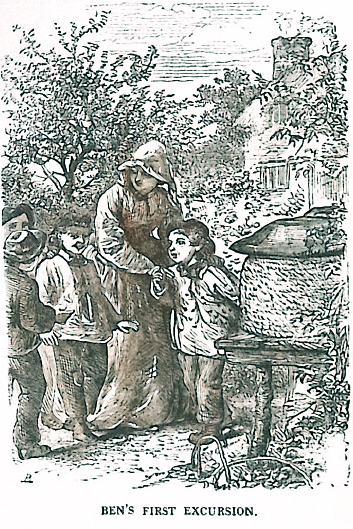
BEN'S FIRST EXCURSION.
"I understand now, aunt, that little hymn which mother taught me a long time ago—
"How doth the little busy bee
Improve each shining hour,
And gather honey all the day
From every opening flower."
"But I don't see any 'cells,' aunt. And where is the 'wax'?"
Then his aunt showed him a piece of a honeycomb, which is always formed of wax, and is divided into numbers of little cells of a six-sided shape.
"How curious, how wonderful!" cried Ben.
There was a brood of ducks swimming about on the pond after their mother, who hissed at Ben, although he assured her he was not going to hurt her pretty young ones.
The three country boys were greatly amused at the anxiety evinced by Ben to gather every little buttercup and daisy he saw; although they kept assuring him that they should see whole fields of them soon. When, at last, after seeing everything about the cottage and garden, they got over a stile, and Ben found himself in a field nearly covered with buttercups and daisies, he was so very happy that tears of joy stood in his eyes. His cousins, who, if rather rough, were thoroughly kind and good-natured, were quite alarmed, and asked him if he were ill, and whether they had been walking too fast for him.
"Oh no," said Ben, "but I am so very happy."
The three rosy-faced boys could not understand how anyone could cry for being happy, and they looked at him more wonderingly than ever. Their mother told them to leave Ben and her sitting on the stile for a little while, and to go and gather some flowers for their cousin. She understood Ben's tears, and felt very kindly towards the pale and sensitive little boy.
And Ben sat on the stile and talked to his aunt in the old-fashioned way he was accustomed to do to his mother at home.
"How beautiful everything is, aunt. This is a beautiful world after all! Do you know, aunt, when I learned the hymn that begins—
"'All things bright and beautiful,
All creatures great and small,
All things wise and wonderful,
The Lord God made them all;'
"I used to think that there were not many bright and beautiful things; and you would have said so too, aunt, if you had lived in our alley. The sparrows look quite a different sort of bird—and I think not only the birds, but the children too look very different. I don't look much like your little boys, do I, aunt?"
His aunt smiled, and told him that in a very little while, she hoped he would look as rosy and as hearty as his cousins.
"Then mother won't know me. Oh! If mother were here, I should be quite happy. Mother is very pale too, aunt: her face is not like yours; and she has to sit in-doors working all day long. That is one reason why I shall be so glad to get strong and hearty. I shall all the sooner be able to work for her."
At this moment, Ben's cousins came running up to him, their hands full of flowers, more than Ben could possibly carry. Then he went and gathered some for himself, and roamed about the fields until dinner time, when he felt so hungry that he did ample justice to the plain but wholesome food set before him.
In the afternoon, he sat in-doors for some time writing a letter to his mother; it was as follows:—
"MY DEAREST MOTHER,—I am quite safe here, and am very well. I hope you
are the same. Aunt and uncle are so kind, and my cousins too; their
faces are fat and rosy, and aunt says mine will soon be so. Every-thing
is beau-ti-ful here; and even the sparrows are pretty. I have more
buttercups and daisies than I can carry. How good God is to send me
here! I wish He would send you also, then I should be quite happy.
"I will ask Him to-night in my prayer.
"Good-by, dearest Mother,
"Your loving boy,
"BEN HOLT."
A few weeks passed away, and no one would have recognized the once pale, sickly Ben in the ruddy-cheeked little fellow who could now walk as far, and eat as heartily, as either of his cousins. They still looked upon Ben with a certain amount of wonder and astonishment, which had been increased by the sight of the letter which Ben had written to his mother. The only one of the family in the wood-side cottage who could write was Mrs. Hunt, Ben's aunt. And her three boys had privately expressed it their opinion that their cousin Ben would be a "parson" some day, for he "talked just like a book, and wrote as well as their mother!"
How had Mrs. Holt been getting on all this time without her boy? She missed him very much—more and more every day—for hers was a lonely, solitary life, and Ben was the one bright gleam of sunshine on her otherwise somewhat dark path. But with all a mother's unselfish love, she would have willingly denied herself any pleasure for the sake of doing him good. As she sat at work in her little room, she would picture to herself the pale cheeks of her child becoming rosy and healthy under the influence of the pure country air; and she would smile and thank God that He had enabled her to procure this blessing for him.
A few days after Ben's departure from home, as she was going down the alley on her way to the shop, to carry home her work, she saw Tom Wade lounging about at his door. He made a movement towards her as she came nearer to him, and then retreated again, as if half afraid. Mrs. Holt had never liked Tom, and had always dreaded him as a bad example to Ben. But now as she looked at him, a different expression in his face from what she had ever noticed before impelled her to regard him more kindly than usual.
Tom saw the change in her countenance and advanced a second time.
"Can I do anything for you, Mrs. Holt, now Ben's away?"
The tone and manner were rough and uncouth, but Ben's mother felt there was some deeper feeling at work in Tom's heart, and she answered kindly,—
"Thank you, Tom, it is very kind of you to think of me. If you will fetch me up a pail of water by-and-by, when I come home again, I shall be very much obliged."
"I'll do it, Mrs. Holt; I'll do it every day if you will let me; say you will," he added, eagerly.
"We shall see about that," she said, smiling.
"Have you heard from Ben?" asked Tom.
"Yes, I had a letter this morning; he is quite well, and very happy."
Tom Wade looked as if he would fain have said more. But somehow he could only mutter, "Thank ye, Mrs. Holt," and shuffled away into his house.
"Poor fellow," thought Ben's mother, as she proceeded on her way, "there's some feeling in him after all."
On her return home, Tom was waiting, evidently on the look-out for her.
"Now may I fetch the water?" he said.
She went up-stairs, and brought him down a pail. He was up with the water almost as soon as she had re-entered her room.
He set down the pail and was leaving the room, when he turned round, and looking hard at Mrs. Holt, said—
"Do you think I could ever be like Ben?"
"How do you mean, Tom?"
"As good as he is—have a 'good name' like his. But no, I'm altogether too bad for that, Mrs. Holt, I'm afraid."
"Never think that, Tom. Ben has no power to be good of himself: it is God's grace which strengthens him; and God will give that grace to you if you ask Him."
"Are you quite sure of that, Mrs. Holt?"
"Quite, quite sure, Tom; the Bible says so, and everything the Bible tells us is true."
"I never thought about such things till lately," said Tom. "I was always laughing and jeering at Ben for what I called his 'pretended goodness,' and I used to set other boys on to tease him too. And so it went on till that day about the half-sovereign, and I was angry with him for not keeping it when he found it, and going shares with me. And then when he ran off to give it to the master, I made sure he'd tell all about me; and I was afraid to go to school the next morning.
"Well, when I heard that he hadn't told of me, I could hardly believe it, and a strange feeling seemed to come over me like. I thought his goodness could not be all pretence; I knew I'd have told had I been in his place. I went to school with Ben that morning, and he talked about you, and how you had brought him up to do right; and I wished I had had such a mother. I thought more than ever that there must be something real in Ben's goodness.
"That morning, when the lady came to the school about her half-guinea, she spoke to all of us boys, and told us the value of the good name that Ben had earned by his honesty.
"'That cannot be all sham,' I thought again.
"When I heard Ben was ill, I felt so sorry. I couldn't tell why, but I felt more sorry than ever I felt for anybody before. I used to long to come and ask how he was; but I knew you thought badly of me, and you had good reason for doing so, and that kept me from coming.
"Since then I have thought more and more every day, 'If I could only be like Ben.'
"At last, I made up my mind to speak to you about it the very next time I saw you; for, I said to myself, if you can make Ben so good—why, at all events, you can set me in the right way. I shall be very much beholden to you, Mrs. Holt, I am sure. And I will gladly fetch water for you every day, or run on errands—that is, if you will trust me," added Tom, colouring, "or do anything I can to repay you."
Mrs. Holt held out her hand to Tom, and shaking it warmly, said—
"My poor boy, you don't know how glad I am to hear you speak in this way. The true beginning of all amendment is to feel that we are really bad. We never can become better until we feel that our hearts are evil. What you must do now is to pray to God to give you His grace, and then you will be able to leave off your bad ways.
"'Create in me a clean heart, O God; and renew a right spirit within
me.'
"No one else but God can do it, Tom; I can only tell Ben what to do."
"How can I ask God to listen to me when I have been so bad?" said Tom.
"We have all of us been bad, Tom—
"'There is none that doeth good, no, not one:'
"That's what the Bible says; and if we depended on our own merits, or on any good works we can ever do, we could never expect God to hear us. The best man that ever lived would fall far short of what God requires; for there is no one that can say he has never sinned; and God has said, through His holy prophet, 'The soul that sinneth, it shall die.' But we have a Friend in whose name and for whose sake we may ask all things of God. That friend is our Saviour, Jesus Christ. He died for us on the cross that we might live; He was bruised for our iniquities; and His precious blood cleanseth from all sin. In His name, believing and trusting in Him, the greatest sinner may go boldly to the throne of grace and ask for mercy. Then we shall show that we believe and trust in Jesus by acting as He would have us do.
"So that being 'good,' as you call it, Tom, is really only the outward sign we give that we love and trust in Jesus; and the evidence that for His sake, God's grace is working in us, giving us strength to do His will.
"If Ben were to profess to love me ever so much," continued Mrs. Holt, "and still to be disobedient and idle, paying no attention to any of my wishes, do you think I should believe in his love for me? Certainly not; and that is why the Bible tells us that 'faith without works is dead,' that is, has no true life in it. We should all pray to God for more faith; it is the root of all our religion. For if we have real faith, we shall show it by our good works.
"Never think, then, you are too bad to amend, Tom. Begin this very day; pray to God from your heart, in Jesus' name, and He will be sure to hear you. Come to me whenever you like; I um rather lonely now my Ben's away, and we can have many a little chat together."
"Do you mean it, Mrs. Holt? Would you really like me to come?"
"Yes, indeed, Tom, and anything I can do to advise you or comfort you, I shall have real pleasure in doing. I know how I should wish others to act by my boy were he in want of a friend."
"You are too good, Mrs. Holt," said Tom, "and I only hope I shall be able to do something for you."
"The best 'something' you can do for me, Tom, is to let me see you become a better and a happier boy."
From that day forward, Tom never missed paying his daily visit to his kind friend Mrs. Holt. She talked to him, sometimes read to him, and made him read to her easy texts, such as he could understand. She encouraged him, also, in many little ways—showed him that she would trust him by sending him on trifling errands for her, thus increasing his self-respect. In the end, she had the great happiness of feeling that she had been a humble instrument in God's hands of doing good to a poor friendless boy.
Had not Ben Holt's good name already been of service to others as well as to himself? It should be a serious thought to every one in the world that we must be doing one of two things—either setting a good or a bad example! It will never do then, to think and live for ourselves alone. What does our Saviour say?
"Let your light so shine before men, that they may see your good works,
and glorify your Father which is in heaven."
Have we grace? Then it must be seen. Have we God's Spirit working in us? Then there must be fruit.
IT was haymaking time, and Ben, with his merry, sun-browned face, made hay every day with a little fork which his uncle had made for him, and shouted as lustily as his cousins as he rode on the waggon in the evening, half buried amongst the sweet new hay. The farm on which Ben's uncle worked consisted almost entirely of pasture land, and the farmer generally gave a treat to his labourers and their wives and children, when the last waggon of hay was safely carried. This treat consisted of a substantial tea in the fields, where long tables were spread with plenty of cold meat, bread and butter, cake, and good tea.
When the meal was over, the children played at a variety of games, whilst the parents sat happily looking on, talking together of the time when they too had been children, and had come to the haymaking feast. Ben's cousins had told him in glowing terms all about the delightful treat to which young and old alike looked forward; and Ben's only regret was that his mother could not be present at it.
He had now been at his uncle's more than six weeks. And much as he had enjoyed himself, he never for a day forgot his mother at home in the narrow, dark alley, but would constantly wish he could share with her his present happiness. His uncle and aunt had become sincerely attached to him, and felt that he had already exercised a very beneficial influence over his sometimes giddy little cousins. They had talked the matter over together, and had agreed to take Ben to live with them altogether, if Mrs. Holt would consent, and if Ben would like it.
One evening, his uncle spoke to him on the subject.
"Well, my boy," he said, pinching Ben's cheeks, "there's something to pinch there now, isn't there? The air of Wood-Side Cottage suits you, Ben, I should rather think; what would you say to living here always?"
"Oh, uncle, I should be happy," cried Ben, joy sparkling in his eyes.
"And we should be happy to have you, Ben, and to bring you up as one of our own. It's not all boys I'd say the same to, I can tell you. But, letting alone that you are of our own flesh and blood, you have been well brought up, and are a credit to your mother, and you may tell her I say so. You have done your little cousins no end of good, for they had run a little wild. I've talked the matter over with your aunt, and if you think you would be happy amongst us, why there is a home for you as long as you like to stay."
Did Ben hear aright? Might he always live in the cottage by the wood-side?
"And mother, uncle?" said Ben, a sudden thought crossing his mind.
"Well, boy, your mother will get along all the better, I fancy, when she has only one mouth to feed instead of two; what do you think?"
"I could not leave my mother, uncle. I am very much obliged to you—more so than I can tell you—but I could not leave my mother, uncle. I am sure she would rather have to work a little harder and have me with her, than do without me altogether. I know how sorry she was to part with me, and how she is longing for me to come back; though she would never say a word, for fear I should go home before I was quite strong. I had been thinking that perhaps I have been selfish to stay away so long. But it was so very pleasant, uncle, and I hope I shall soon be strong enough to work and earn some money to help mother. I am an inch taller than Willie; and please don't be angry with me, nor think that I do not love you and thank you very much for all your goodness, but I cannot forget my mother."
Honest, kind-hearted Will Hunt brushed away something very like a tear from his eye.
"We would be the very last to ask you to do it, Ben, so never fear on that head. Your love for your mother does you both credit. But suppose we ask her what she thinks of the plan?"
"I know what she would say, uncle. She would deny herself anything if she thought it was for my good, but all the while it would almost break her heart. Mother has no one but me, uncle." And Ben looked entreatingly up in his uncle's face.
"You are a good little fellow, that you are, Ben. And you will always have me for a friend, come what will."
"Uncle, I think I ought to be going home soon, because I am quite strong now."
That evening, Will Hunt and his wife had a long consultation together. But no one but themselves knew what it was about, although it seemed to end very pleasantly, judging by the cheerful looks which Will Hunt exchanged with his wife as they sat at supper, and the kind glances they cast from time to time towards Ben, who sat eating his bread and milk, just like a little plough-boy, as his uncle said.
The next morning, Mrs. Hunt was very busy writing a long letter. She hurried it out of the way when Ben came home to dinner with his cousins, as if she did not want him to see what she was doing. What could it all mean?
Then in a few days' time, there was great sending to the post-office to see if there was any letter for Mr. Hunt: and at last, one came. Farmer Hunt seemed quite merry.
At length, the great day of the haymaking feast drew near.
The weather was bright and cloudless, and the air was full of the pleasant sounds and sweet odours of summer. Birds were singing, bees were humming; and, pervading everything, the sweet smell of the new hay, mingled with that of the honeysuckle from the luxuriant hedges that enclosed the meadows. There was still a good deal of hay to be carried on this the last day of the hay harvest, and all hands were busily employed from very early in the morning. It was with great surprise, therefore, that Ben saw his uncle go and clean himself after dinner, instead of returning to the hayfield, and set off, shortly after, in the chaise cart which had brought Ben from the station.
"Business must be attended to, Ben," he said, nodding merrily at the boy as he drove away.
Ben returned to the hayfields with his cousins, and worked hard all the afternoon.
"To-morrow, to-morrow," was in every one's mouth; and Ben thought if his mother could only be there, he would give all that he possessed in the world.
At last, with many a shout and joyful hurrah, the last waggon-load was carried, but not until quite late in the evening. And it was nearly seven o'clock when Ben left the meadows, and accompanied by his cousins, proceeded homewards.
"Father is come back, I know," said Willie; "I saw the cart coming up the lane."
"There is mother at the gate watching for us," cried Charlie, the youngest of Ben's cousins; "and there's somebody standing by her; I wonder who it can be!"
"Look at Ben, how he is running!" the three cousins cried altogether, a minute afterwards.
Ben had given but one glance at the "somebody" who was standing by his aunt's side, but that was enough. And he flew rather than ran towards the garden-gate of his aunt's cottage.
"Oh, mother, dear mother!" he cried, as he sprang almost breathless into his mother's arms.
This, then, was the secret that kind Mr. Hunt and his wife had been laughing over so merrily the last few days.
He had sent money to London to pay for his sister's journey down, to stay a few weeks with them. And, wishing to surprise Ben, had said nothing to him about it.
"Well, young one," he said to Ben, who looked the very picture of happiness, as he stood with his mother's hand fast locked in his, "was I not right to go and attend to my business after dinner to-day?"
"You dear, good uncle," cried Ben, "I little thought what you meant at the time."
Mrs. Holt could scarcely believe it to be her once sickly little Ben she saw before her. Health beamed in his bright eye; and certainly there was not a trace of delicacy in his ruddy brown cheeks and firm stout limbs. She felt her heart full of thankfulness to God who had ordered all things so well for her dear child, and had made him find such friends in his uncle and aunt.
The next morning Ben led his mother through all his favourite fields,—and she told him all about her own childhood, and what she had done, and how happy she had been years ago in the same fields, and living in the same cottage. She told Ben, also, about poor Tom Wade; and how he had become a steady, well-behaved boy, and had found regular work as a bricklayer's lad, and now earned four shillings a week. Next to his mother's coming to the cottage by the wood-side, nothing could have given Ben greater pleasure than to hear this good news about Tom.
"He goes regularly to the Sunday-school, now, Ben," said his mother; "and his father told me yesterday morning, before I left home, that Tom was far less trouble than he used to be. His father is not a steady man, you know; and at first he was against Tom's going to school on Sundays. But he is now quite reconciled to it, and said—'for aught he knew, the Sunday-school might have something to do with Tom's better behaviour; he couldn't say, but it was just possible.'"
"I am sure it had, mother."
"Yes, Ben, I quite agree with you in thinking that the effects of the teaching received there, acting upon Tom's softened heart, may have greatly influenced his conduct; but we must look still higher for the real cause."
"You mean God, mother?"
"I do; all that we poor human beings can do is to sow the seed. The farmer can sow seed, but he cannot command a single blade of grass, or ear of corn, to grow. He cannot explain why some grains come up, and others die. These are matters which he must leave alone. He sows the seed, and leaves the growth to God—
"'God giveth the increase.'
"The growth of God's grace in the human heart is, in like manner, a mystery to us. Ministers and teachers may preach and teach, but God alone can give life to the seed they sow in the heart. But it is our duty to sow the seed; that is our work. That done, we may wait for the result in faith and patience. God alone can, and if He thinks fit, He will give success."

IT was a pleasant sight to walk through the newly-mown meadow on the afternoon of the haymaking feast. You might have looked in vain for an unhappy face. Smiling contentment beamed on the countenances of the parents, joyous mirth on those of the children, and a peaceful tranquil happiness on the old men and women of the village, whose children and grandchildren sat around them. The owner of all those fair acres was there too, vying with his wife and family in kind attention to the comfort of the guests, and with a word of friendly sympathy for all.
"There is that scattereth, and yet increaseth," says Solomon; and every one entrusted with riches who makes a good use of the dangerous gift, and dispenses liberally abroad to his poorer neighbours, receives a hundredfold into his bosom, in the pure and unalloyed happiness he feels. Truly, "it is more blessed to give than to receive;" and, to take a purely selfish view of the great duty of Christian charity, they little know what they lose who shut up their talents in their strong box, and wilfully close their eyes, and ears, and hearts, to the sorrows and wants of their fellow-creatures.
The village pastor, too, was there; a silver-headed, reverend-looking man, who had faithfully laboured to lead the way to that bright land to which he was hastening. He had opened the proceedings by a few simple, earnest words, setting before his hearers the gratitude they ought all to feel to God who had "visited the earth," and made it so fruitful. He spoke of all harvest times as seasons which might be sanctified to them all, and leave them, he hoped, better than it had found them, by bringing more closely to the hearts of all the comforting truth that "God's never-failing providence ordereth all things both in heaven and earth."
Then a harvest hymn was sung, in which young and old joined heartily; after which the tea commenced.
Well does our sweet poet Cowper speak of tea as "the cup that cheers but not inebriates;" and it must be a source of great pleasure to all interested in the well-being of the working classes, to find that the "Monster tea" is fast becoming quite an institution in England, and that by substituting it for the dinner which used formerly to celebrate the harvest home, it puts out of the way all danger arising from that subtle enemy, strong drink, which has done, and still does, so much mischief, and which casts its dark shadow over so many cottage homes. The wives and children too can join in the tea party, which is a great advantage; and thus the social domestic virtues are cultivated.
After a considerable amount of cold beef and bread, and plum cake, and good tea had disappeared, the games commenced for the younger members of the party, the elder ones looking on, and talking over their youthful feats at such merry-makings. During the afternoon, a number of ladies and gentlemen who resided in the neighbourhood, came to see the village festival, and joined heartily in the sports which were going on.
As to the children themselves, never was there a merrier set of little beings. They ran races for toys and fruit; the bigger boys jumped in sacks, to the great amusement of the spectators, and all was innocent glee and merriment.
Ben Holt had won a race, for which a beautiful ball was to be given as a prize by one of the visitors present. And as he came forward to receive the ball, he recognized the face of the lady who had been so kind to him on his journey. Ben had improved so much in appearance that his kind friend had not known him before. But now, as he came near to where she stood, something in his face struck her as familiar, and she looked hard at him. Ben coloured and smiled.
"I really did not know you at first, Ben," she said; "country air has done wonders for you indeed! How is your mother now? Is she quite well?"
"Quite well, thank you, ma'am, and she is here too," said Ben, gleefully, pointing to a form on which Mrs. Holt was sitting with her sister-in-law, Mrs. Hunt.
Ben ran off again to his companions, and the lady, whose name was Mrs. Murray, went up to Mrs. Holt and spoke very kindly in praise of Ben, and of how much credit there was due to her for having brought him up so well, and told her how pleased she had been with his manner and whole behaviour the day they travelled together. You may be sure this praise of her child was very sweet to Mrs. Holt. If children could only know the happiness they cause their parents when they strive to act properly, and the inexpressible misery they inflict when they pursue a different course, it would make them more careful about their conduct.
Mrs. Murray was niece to Mr. Harvey, the pastor of the village. And that gentleman came and spoke to Ben and his mother, telling the former that he remembered his mother when she was no bigger than Ben was then, and that he had always found her one of the best and most attentive of his Sunday scholars.
"You never can be too thankful to God for giving you a good mother, Ben," said the kind clergyman; "you little know what you might have become otherwise."
Ben thought of poor Tom Wade, and felt the truth of what Mr. Harvey said.
The happiest day must come to a close; and after many hours' enjoyment, the party separated, after having sung "God save the Queen" so lustily that the meadows echoed with the sound of their voices. Then they all wended their way to their peaceful homes, without one regretful feeling to embitter the remembrance of the haymaking feast. Would that all village merry-makings might have a like termination!
William Hunt made the same proposal to his sister, respecting her son, that he had done to Ben himself. He offered to relieve her from any future expense concerning him, and to bring him up with his own children. Mrs. Holt thanked her brother most warmly for his kindness, but said she would leave the decision entirely to Ben.
"You know I would never leave you, mother," said Ben, after he had a second time gratefully refused his uncle's generous offer.
"Then we must say no more about it, Mary," said Will Hunt to his sister, "but you must both of you manage to come down and see us every summer for a bit."
Mrs. Holt stayed nearly a month in her old home. She had brought some shop work with her, so that she was still earning something, as, after the first day or two, she used to sit at needlework the greater part of every morning. Her own health had greatly improved under the influence of her native air, and when she and Ben bade farewell to their good friends, and returned to London, they both felt that they had laid in a good stock of health and strength, which, with God's blessing, would enable them to get bravely through the winter.
And so it did. Mrs. Holt had plenty of work, and what is more, plenty of health to get through it, and Ben attended school regularly, and made great progress.
The following summer they paid another visit, although not so long a one, to the cottage by the wood-side, and then came another winter which passed pleasantly away and left them in health, and doing tolerably well. In the spring that followed, Ben was twelve years old, and he began seriously to think of getting something to do. He could read and write remarkably well, and was very quick at figures. But unfortunately, he was small for his age, and his mother feared that would be considerably against him. Mrs. Holt had no friends in London to whom she could apply; for Mr. Marland, the worthy schoolmaster, had left long ago, to live in the country.
Ben was thinking over the matter one day as he was returning home from taking some work to the shop for his mother. When passing through a street in which there were a great many booksellers' shops, he read the following notice in one of the windows:
"AN EXPERIENCED
ERRAND BOY WANTED.
Inquire within."
Ben did not quite understand the meaning of the word "experienced," but he thought to himself he should do very well for an errand boy, and he summoned up courage to go into the shop. There was no one in the part that was near the door. But at the farther end, there was a sort of little counting-house lighted by a skylight in the roof, and Ben could see the heads of two or three people who were sitting writing at very high desks.
He hardly liked to go and disturb them, and felt more than half inclined to go out of the shop again. But a favourite saying of his mother recurred to him,—
"A bad action is the only thing we need ever be afraid of."
And he walked up the long shop towards the little counting-house at the end, feeling that he was not doing anything wrong, but was only anxious to earn an honest living. He walked so quietly, and made so little noise, that no one heard him approach. He stood still for a moment, and then gave a modest little tap on the counter.
"What do you want?" said a gruff voice, the owner of which still kept on writing, and never so much as raised his eyes from the desk.
"If you please, sir, there is an errand boy wanted here, isn't there?"
"Umph, yes," and a pair of very industrious eyes peered down upon Ben. "How old are you?"
"Twelve, sir."
"What situations have you held?"
"Please, sir, I have never been in one at all yet; but I have been to school, and I can read and write, and—"
"That's enough; it is a pity you could not read that we wanted 'an experienced errand boy,' and not one who knows nothing."
"Do you not think I will do then, sir?" asked Ben, in a sad tone. "I would do my best."
"And that would be but bad, I reckon; no, you won't do."
Ben felt quite disheartened, and was about to turn round and retrace his steps down the long shop when one of the other heads looked down on him with a sharp glance. This head was covered with very grey hair, and a pair of spectacles was pushed high up on the forehead.
"Where do you live, my boy, and what is your name?"
The voice was rather stern, but much less harsh than the former one.
"My name is Ben Holt, sir, and I live in White Horse Alley, No. 2, three pair back."
There was a noise in the little counting-house like the pushing back of a stool, and then the grey-headed gentleman came out into the shop, and looked attentively at Ben.
The two clerks in the counting-house left off writing, and both gazed into the shop to see what their master wanted with the boy; for the old gentleman in spectacles was the master of the shop, and the man with the harsh voice was only the foreman.
"Did you ever see me before, Ben Holt?"
Ben looked at the speaker: but although there was something in his face and in the tone of his voice that seemed familiar, he could not recollect whether he had seen him before or not.
"Then my memory is better than yours, youngster, and it is lucky for you that it is. Did you ever pick up a humming-top, Ben?"
"Oh, sir, I recollect you now; you are the kind gentleman who saved me from being taken up by the policeman."
"The same," said the old gentleman, with a smile; "and do you remember my saying to you, that you would live to find the value of the good name you then began to earn for yourself?"
"Yes, sir," said Ben, "I remember it all."
"Well, my boy, I should like to prove to you the truth of my words. We want an errand boy, one who has had some experience if possible. You have had none, you say—that is against you certainly; but I weigh your good name against your inexperience, and feel inclined to try you. At all events, I will call and talk it over with your mother some time to-day or to-morrow. Tell her she may expect me."
Ben scarcely knew how to express his thanks; his little heart was very full.
But the gentleman seemed to understand it all, and went back into his counting-house.
And then Ben soon found his way into the street, and ran home as fast as he could.
Mr. Lancaster, the bookseller, called according to promise, and had a long conversation with Ben's mother, the result of which was that he agreed to take Ben for a month on trial, at five shillings a week.
"We want a boy whom we can trust, Mrs. Holt," continued Mr. Lancaster. "And although it would have been a great advantage if Ben had been more experienced, and had known town well, still I am quite willing to waive that point, in consideration of his good character. It is a great thing for a boy to begin life as you are doing, with a good name," said he, turning to Ben, who was standing by, with a face radiant with happiness. "And I wish you to feel that it is so; it will be the greatest possible incentive to your future good conduct. What do you say to beginning work to-morrow? Are you ready?"
Ben was quite ready, and entered on his new duties the very next day. His good character had preceded him, and he found that the foreman and shopmen all treated him with considerate kindness. Mr. Lancaster had told them that Ben was an honest, trustworthy lad; and although he was but an errand boy, they felt that respect for him which good conduct is always sure to inspire.
Ben had to work very, very hard, and walk many miles every day. Often, when he got home at night, his legs would ache so much that he could have cried with the pain. But he was a brave boy, and bore it all without a murmur, and his mother never knew what he suffered. Before the month had expired, however, he had become accustomed to the exercise, and his legs no longer pained him, whilst being so much in the open air was rather good for him than otherwise. He gave his master so much satisfaction during the month's trial that at the expiration of the time, he was regularly engaged by Mr. Lancaster.
The shopmen too, liked Ben, who was always ready to oblige them, and was so civil and good-tempered that they never heard him complain. He became such a favourite with them that they frequently gave him a good meal when they were having their own dinner or tea. All this was a great help, and Ben regularly carried home his five shillings to his mother on Saturday night.
Mrs. Holt, after buying him what clothes he required, put the remainder into the savings' bank, to make a little fund for her boy, should an opportunity occur at any future time of binding him to some good trade.
Mr. Lancaster was a very rich man, and had a beautiful country house near London. He used to go down to it every night, and come into business every morning. And two or three times during the summer, he made it a practice to invite his shopmen by turns to go down to his country house on Saturday night after business was over, and spend a pleasant Sunday in the country.
Ben and his mother also spent two happy Sundays at Oakfield—that was the name of the place—for Mr. Lancaster thought a little fresh air would do the poor hard-working needlewoman good. There was a small farm-house on his property, and in it were two bed-rooms always kept expressly for the accommodation of his humble guests, and they were very seldom empty during the summer months. Many a sick child belonging to some of his London workpeople has recovered health and strength by a week or two in the pure country air at Oakfield; and many a delicate wife and mother, unable to afford the expense of change of air, has been restored to her family after a fortnight's rest and good living at the farm-house at Oakfield. No wonder that Mr. Lancaster's name was spoken with blessings by all who knew him.
Mr. Lancaster soon discovered that Ben was fond of reading, and he lent him instructive and entertaining books for him to read when at home. So Ben's education did not cease because he had left school and was earning his living. Every boy can improve himself greatly by devoting an hour or two each evening to reading and writing. Such profitable occupation is far better than idly lounging away the time, as many boys do when they go home from work.
And so time passed on, until Ben was nearly fifteen years old, when Mr. Lancaster offered to take him as a counter lad in place of one who had lately left. This was a great rise for Ben; he had now eight shillings a week, and many opportunities of improving himself. He had grown very much the last two years, and was no longer small for his age, and he had been enabled to preserve his good name amidst all the numberless temptations of a London errand boy's life. But then he had not trusted in his own strength to keep him from falling, and that was the secret of his success.
"Hold Thou me up, and I shall be safe," was Ben's constant daily prayer
to the throne of grace.
And God heard the prayer, and answered it.
Ben's only care was about his mother. Her health had been failing for some months; and although she never complained, but worked on as industriously as usual, Ben saw that she became thinner and paler every day. And it was not now on account of not having sufficient nourishment, for Ben had insisted on her using part of his wages, and she had plenty of good food. Still she did not get strong. She had spent a fortnight at Oakfield Farm, and whilst there, her strength seemed to return. But immediately on her return to White Horse Alley it failed again, and Ben became seriously uneasy.
"I want to talk to you about your mother, Ben," said Mr. Lancaster one morning.
Ben turned pale. His master then had likewise noticed the change in her looks; if so, she must be very ill.
"She is not looking well, lately."
"No, indeed, sir," said Ben, the tears starting to his eyes.
"She ought to live in the country."
"She could not manage that, sir, on account of working for the shop."
"I have been thinking about the matter, Ben," said his master; "and I have a proposal to make to her. You know the little ivy-covered lodge at the entrance to my grounds? Well, I want some one to live in it, and answer the gate. If your mother would like it, she shall have the lodge rent free and five shillings a week, for I suppose you would be wanting to spend your Sundays at Oakfield then?"
Ben wept, and seized his kind master's hand, but he could not speak a word.
"There, there, set off home and consult her at once, boy, and let me know before I leave business this evening."
"How can I thank you sufficiently, sir?" said poor Mrs. Holt, about an hour afterwards, when she had accompanied Ben back to his master's shop.
"You owe me no thanks, Mrs. Holt. I want a steady, trustworthy person to keep my lodge, and I know you to be such. You must thank your own and your son's 'good name,' and above all that God who has enabled you to make yourself respected."
In less than a fortnight, Mrs. Holt was happily settled in the pretty ivy-covered lodge, and Ben was taken by his master to live at the shop in London. Every Saturday evening, he walked down to Oakfield to spend Sunday with his mother, whose health was soon completely restored. Ben continued to rise in his master's esteem, and soon began to attend an evening school where he learned bookkeeping. He did this by Mr. Lancaster's advice, and before he was twenty, became one of the junior clerks in the business, and used to sit perched up on one of those high stools on which the foreman sat on that memorable day, nearly eight years before, when Ben had so timidly walked up the long shop.
————————————————————————————————————————
Pardon & Sons, Printers, Paternoster Row, London.